Got a Copyright Notice From Your ISP? What It Means (US, UK, Canada)
A copyright or DMCA notice from your ISP is a forwarded allegation, not a lawsuit. A rights holder, usually through a monitoring company, saw your account's IP address in a file-sharing swarm and asked your provider to pass a warning on. In most cases nothing else happens. What can happen next depends on where you live: in the US, repeated notices can lead your ISP to suspend or end your service; in Canada, the notice itself carries no obligations at all; in the UK, ISPs no longer send warning letters of this kind.
This page explains what the notice is, how it works in the US, Canada and the UK, what to do in the first 48 hours, and when a lawyer becomes worth the money. It is general information, not legal advice, and it is not about avoiding detection. If the notice is right, the fix is to stop sharing that file. If it is wrong, the steps below help you work out why.
What the notice is (and isn't)
Rights holders and the firms they hire join public BitTorrent swarms for files they own and log the IP addresses that offer pieces of those files. An IP address leads to an internet account, not to a person, so the rights holder cannot tell who you are. It sends the IP address, a timestamp and the file details to the ISP that owns that address, and the ISP matches the time and address to a subscriber and forwards the message.
A notice is therefore evidence that something on your connection was seen sharing a particular file at a particular time. It is not proof that you did it, it is not a court document and it does not mean you have been sued. Canada's consumer affairs office puts it plainly: receiving a notice does not necessarily mean you have infringed copyright or that you will be sued, and a notice is separate from any lawsuit. The same logic applies elsewhere.
A notice tells you what was seen on your connection. It does not tell you who did it, and it is not a claim for money. Treat any notice that asks you to pay through a link with extra suspicion.
US, Canada, UK: how notices work
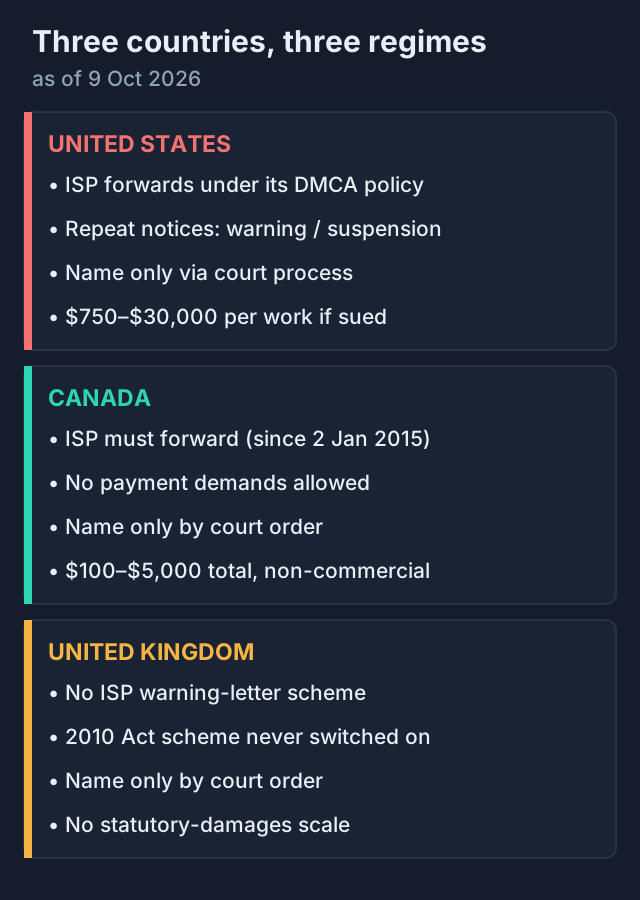
The three countries handle notices very differently, which is why advice copied from a forum thread in another country can mislead you. The table sums up the position as of 9 October 2026; the sections after it give the detail and the sources.
| United States | Canada | United Kingdom | |
|---|---|---|---|
| Are ISPs required to forward notices? | No statute requires it; ISPs that forward them do so under their own policies | Yes, under the notice-and-notice regime (in force 2 Jan 2015) | No; the 2010 scheme was never switched on |
| Can a notice demand payment? | Not regulated; settlement offers do appear | No; settlement offers and payment demands are not allowed since the 13 Dec 2018 amendment | No ISP letter scheme running |
| Does the ISP reveal who you are? | Only under a court process, such as a subpoena in a lawsuit | Only if a court orders it | Only under a court order |
| What can the ISP itself do? | Warn, suspend or terminate repeat infringers under its DMCA policy | Must forward and keep records; no penalties on you from the notice | Depends on the ISP's terms |
| Statutory damages if sued | $750–$30,000 per work; up to $150,000 if wilful | $100–$5,000 in total for non-commercial infringement | No statutory-damages scale; the court assesses damages |
A note on the UK row: UK law has no US-style statutory damages, so a claimant has to prove its loss. We have kept that point general because the amounts in UK cases vary widely and we have not reviewed them.
United States
No US law makes ISPs forward copyright notices. They forward them because of the DMCA. To keep the legal safe harbour in 17 U.S.C. section 512, a provider must adopt and reasonably implement a policy that provides for the termination, in appropriate circumstances, of subscribers who are repeat infringers. So the practical risk from notices in the US is to your service: a string of notices can lead to warnings, a temporary block, a requirement to call the ISP, or termination, depending on your provider's policy.
The industry-wide Copyright Alert System, the so-called six strikes scheme run with AT&T, Comcast, Verizon and others, ended in January 2017, so each ISP now applies its own policy. In March 2026 the Supreme Court decided Cox Communications v. Sony Music Entertainment, holding that Cox was not contributorily liable for its subscribers' infringement. That changes the pressure on ISPs rather than your own position: individual infringers can still be sued. If a rights holder sues over a swarm, it typically files against an unidentified defendant and asks the court to let it subpoena the ISP for the subscriber's name. A court case is where the statutory damages in the table come in.
Canada
Canada has the most consumer-friendly rules. Under the notice-and-notice regime in the Copyright Act, which came into force on 2 January 2015, an ISP that receives a compliant notice must forward it to the subscriber, tell the rights holder it has done so, and keep records identifying the subscriber for six months, or a year if the rights holder starts proceedings. Since an amendment dated 13 December 2018, a notice may not contain an offer to settle, a demand for payment or a request for personal information. The government's consumer page says the regime imposes no obligations on a subscriber who receives a notice, that you do not have to contact the rights holder or the ISP, and that your ISP will only release your details if a court orders it.
If a case did go to court, statutory damages for non-commercial infringement are capped at between $100 and $5,000 for all the works involved in the proceedings, which is far below US levels.
United Kingdom
The Digital Economy Act 2010 created a framework for ISPs to send infringement letters to subscribers, but only under an initial obligations code that was never brought into force. A voluntary scheme of educational warning emails, sent by BT, Sky, TalkTalk, Virgin Media and other ISPs under the Creative Content UK campaign, was stopped in July 2019, as ISPreview reported at the time. A rights holder who wants to pursue a UK subscriber has to go to court for an order requiring the ISP to disclose who the account holder is, and then pursue that person.
What to do in the first 48 hours
Most notices need a calm read, a few minutes of checking and a change of habits, nothing more. These steps work in all three countries.
- Check it is genuine. A real notice comes from your ISP, through its usual email address or account messages, and names a file, a time and an IP address. Be wary of messages that push you to pay through a link or ask for personal details; in Canada those terms are not allowed in a forwarded notice at all.
- Read what is alleged. Note the title, the date and time, and the IP address. Your router's admin page or ISP account usually shows your public IP, so you can see whether it matches.
- Find the source. Check which devices and people were on your connection at that time: family members, flatmates, guests, a games console, a media server, or a torrent client left running in the background.
- Stop the sharing. If the file is something you or someone in your home had no right to share, remove it from the torrent client. Seeding continues after a download finishes, which is how many people get notices for things they forgot about.
- Keep a copy. Save the notice and any reply from your ISP. If more arrive, the record helps you or a lawyer later.
- Do not ignore escalation. One notice is common. A second or third, a call from your ISP, or a letter from a law firm is the point to take advice.
If the notice concerns a file you had every right to share, such as an openly licensed release, keep the licence details with the notice. Misidentification does happen, and your ISP will usually explain how to dispute a notice under its policy.
Settlement letters and when to get a lawyer
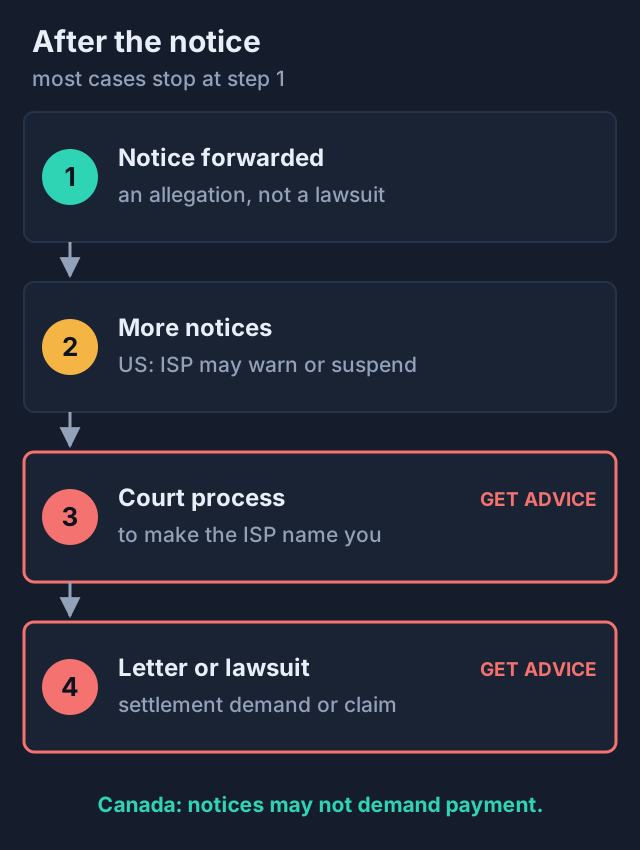
A settlement letter is different from an ISP notice. It comes from a law firm or rights holder, names you personally, and asks for money to make the matter go away. Getting one usually means your details were obtained through a court process. In the US and the UK that is possible after a court order; in Canada, settlement demands cannot be included in a forwarded notice, so a demand that arrives inside one is non-compliant.
Speak to a lawyer who handles copyright cases in your jurisdiction if you receive any court document, a subpoena notice from your ISP, a law-firm letter that names you, or a demand for payment. Do it before replying, paying or admitting anything, because what you say can matter later. Many lawyers will look at a letter for a fixed fee. Where you have home insurance or a legal-expenses policy, check whether it covers advice. For background on where the legal line sits, see our guide to whether torrenting is legal.
Keeping your connection secure (Wi-Fi, guests)
If a notice came from someone else using your connection, the fix is to control who can use it. Canada's consumer affairs office suggests the same first step: secure your home network with a strong password. Practical measures include:
- Change the router's Wi-Fi password and its admin password, and use WPA2 or WPA3 encryption.
- Put visitors on a separate guest network, and switch it off when it is not needed.
- Check the router's list of connected devices for anything you do not recognise.
- Look for torrent clients set to start with the computer, and for media servers or plugins that fetch content automatically.
- Agree house rules with flatmates or family about what may be downloaded on a shared connection.
None of this is about hiding activity. It makes sure that what happens on your account is something you know about. A VPN encrypts traffic and changes the IP that peers see, which protects the privacy of lawful file sharing, but it does not make sharing copyrighted files lawful, and it is no defence to an infringement claim. We cover what a VPN does and does not change in does a VPN hide torrenting from your ISP, and what to look for in one used for lawful P2P in our best VPN for torrenting guide.
Edge cases
- Shared houses and landlords. The notice goes to the account holder, who may not be the person who shared the file. If you provide internet to tenants, check your ISP's terms on responsibility for the connection.
- Wrong IP or wrong time. Home IP addresses change. If the time on the notice falls before you moved in or switched providers, say so to your ISP.
- University and work networks. These run their own acceptable-use policies, and notices may lead to internal action rather than ISP warnings.
- Scam notices. Emails that imitate an ISP and demand payment by card or crypto are a known trick. Log in to your ISP account directly to check whether a notice really exists.
- Lawful files. Seeding Linux images, public-domain media or your own work does not infringe anything, and a notice about such a file is a mistake worth disputing.
Copyright notices from your ISP: FAQ
What does a DMCA notice from my ISP mean?
Can I be sued after a copyright notice?
Should I respond to a copyright infringement notice?
Will my ISP give my name to the copyright holder?
Can I get a copyright notice if I only torrent legal files?
Ready to pick one? See the best VPNs for torrenting, compared, or start with whether torrenting is safe in the first place.